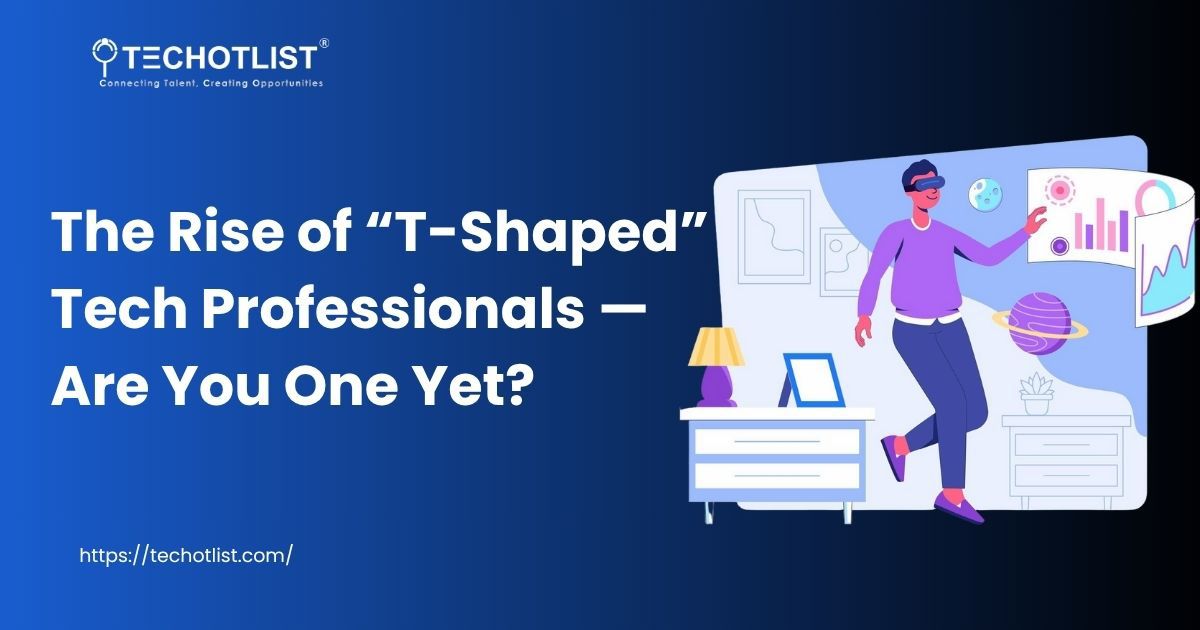
The Rise of T-Shaped Tech Professionals in 2026: Why It Matters for Your Career
In the fast-evolving world of technology, versatility is becoming more valuable than specialization alone. In 2026, the AI impact on tech jobs is accelerating this shift, pushing professionals to move beyond narrow expertise and develop broader, cross-functional capabilities.
Employers today aren’t just looking for deep technical skills, they want individuals who can collaborate across disciplines, think strategically, and adapt quickly. This is where T-shaped tech professionals stand out as a key driver of success in the modern workforce.
If you're wondering what it means to be “T-shaped,” how it impacts hiring, and how to shape your career accordingly, this guide will give you a clear roadmap.
What Is a T-Shaped Tech Professional?
A T-shaped professional is someone who combines depth with breadth:
- Deep expertise in one domain (the vertical bar of the "T")
- Broad knowledge across related areas (the horizontal bar)
In today’s landscape, this might look like:
- A cloud engineer skilled in AWS who also understands DevOps workflows and security
- A data scientist who not only builds models but communicates insights and supports product decisions
In 2026, becoming a T-shaped tech professional is one of the most effective ways to stay relevant as roles evolve.
Why T-Shaped Professionals Are in High Demand in 2026
As the future of tech jobs shifts toward AI-assisted workflows and lean teams, companies are prioritizing adaptable talent.
1. Interdisciplinary Collaboration
Modern tech teams operate across functions, engineering, product, design, and business. T-shaped professionals can bridge these areas, improving communication and execution.
2. Faster Adaptation to Change
With constant changes in tools, frameworks, and AI capabilities, having broader exposure allows professionals to quickly pivot and learn new skills.
This adaptability is critical due to the growing AI impact on tech jobs, which is continuously reshaping role expectations.
3. Better Decision-Making
When professionals understand both technical and business perspectives, they make more informed decisions that improve product quality and outcomes.
How to Become a T-Shaped Tech Professional
1. Identify Your Core Specialty (Vertical Skill)
Ask yourself:
- What is your strongest technical skill?
- Where do you create the most impact?
Examples:
- Backend development
- Cloud architecture
- Frontend engineering
- Machine learning
Tip: Continue strengthening your core expertise through projects, certifications, or advanced learning.
2. Build Adjacent Skills (Horizontal Growth)
Choose 2–4 complementary skills that expand your capabilities:
- Soft skills: Communication, leadership, stakeholder management
- Technical breadth: APIs, DevOps, CI/CD, cloud basics
- Business understanding: Product strategy, customer needs, ROI
Tip: Focus on skills that directly support your current role or team challenges.
3. Apply Your Skills in Real Projects
Becoming T-shaped requires practical application, not just learning.
Look for opportunities to:
- Collaborate with cross-functional teams
- Participate in product discussions
- Review work outside your main domain
- Mentor or support teammates
Real-World Example: Becoming T-Shaped in Action
Case Study: Priya – The DevOps Engineer Who Bridged Teams
Priya started with deep expertise in Linux and Kubernetes. As her company transitioned to microservices, she expanded her knowledge into frontend workflows and testing processes.
She collaborated with multiple teams and contributed beyond her primary role.
Results:
- Reduced deployment failures by 25%
- Improved incident response time
- Recognized as a key cross-functional contributor
Priya didn’t replace her specialization, she expanded it.
Frequently Asked Questions (FAQs)
Q1: What are the rising tech jobs in 2026?
Rising tech jobs in 2026 include AI/ML engineers, cloud architects, cybersecurity specialists, and data engineers. These roles are growing rapidly due to the increasing AI impact on tech jobs and digital transformation across industries.
Q2: What tech skills are in demand in 2026?
The most in-demand tech skills include cloud computing, AI/ML, DevOps, cybersecurity, and data analytics. Alongside these, transferable skills like communication and adaptability are essential for long-term career growth.
Q3: How is hiring in 2026?
Hiring in 2026 is more selective and skills-focused. Companies are prioritizing T-shaped tech professionals who can contribute across multiple domains while maintaining deep expertise in one area.
Q4: What effect will technology have on careers in the future?
Technology will continue to reshape careers by automating repetitive tasks and increasing demand for strategic and creative roles. The future of tech jobs will favor professionals who can adapt, collaborate, and work effectively alongside AI.
Key Takeaways
- T-shaped professionals are highly valued in modern tech teams
- Depth + breadth = stronger career resilience
- Cross-functional collaboration is now essential
- The future of tech jobs favors adaptable, multi-skilled professionals
What Tech Skills Are in Demand in 2026?
In 2026, the most in-demand tech skills include AI/ML, cloud computing, cybersecurity, DevOps, and data analytics. However, technical expertise alone is no longer enough.
Companies are increasingly prioritizing T-shaped tech professionals who combine deep technical knowledge with transferable skills like communication, adaptability, and cross-functional collaboration. This combination helps teams move faster and make better decisions in an AI-driven environment. This shift is also creating demand for specialized, high-paying AI jobs in 2025 across the tech industry.
Final Thought: Start Building Your “T” Today
In 2026, career growth in tech is no longer just about specialization, it’s about adaptability. As AI continues to reshape roles, professionals who can integrate knowledge, collaborate effectively, and think beyond their domain will have the strongest advantage.
Becoming a T-shaped tech professional is not just a trend, it’s a long-term strategy for staying relevant, valuable, and future-ready.
Related posts
The Biggest Career Mistake: Drifting Without Intention (Why Passive Careers Cost You 10 Years You’ll Never Get Back)
23 Apr 2026
“How to Know If It’s Time to Switch Roles (5 Honest Signs, Before You Impulsively Quit)”
23 Apr 2026
Why Most People Feel Stuck in Their Careers (It’s Not the Job, It’s These 5 Hidden Traps)
23 Apr 2026
US Work Visa Layoffs: Rights, Grace Period & What to Do After Job Loss
16 Apr 2026
Why High-Paying Tech Jobs Feel Meaningless in 2026
17 Apr 2026